
Regulatory Landscape of AI in Healthcare II

The debate over how the FDA should regulate the emerging solutions that use AI for healthcare applications is one that is attracting opposite but truly equally valid points of view. Baku Patel, former head of the FDA Digital Health unit, laid out the rationale for the lighter touch approach by the FDA. He indicated […]
Regulatory Landscape of AI in Healthcare I

Before any new diagnostic or therapeutic, or technology can be used in the practice of healthcare, it has to be deemed safe and effective by certain regulatory bodies. US, EU, Japan, and others have robust requirements for such approvals. This has been the case historically for drugs and medical devices. However, there is a question […]
Mitigating Risk of AI Algorithm Deployment

Evidence-based AI is not exclusive to showing that AI algorithms will improve patient outcomes, improve clinical workflows, or lower the cost of care. Currently there is a great deal of variability in risk-mitigating AI development and deployment practices. Current or continuously emerging evidence and experience with AI development or deployment will allow for mitigation of […]
What Evidence Will Cut it for AI Solutions in Healthcare?

My discussions with many of the experts in AI in Healthcare has highlighted the fact that well-designed, large-scale, multi-center trials have not been done so far. These types of trials would establish the efficacy and safety of these algorithms in the real-world settings where there are different types of patients. Also, the algorithm gets tested […]
Myriad of Issues Facing Adoption of AI in Healthcare
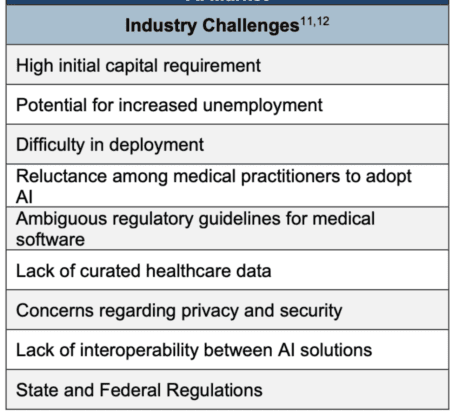
According to a survey of over 12,000 participants conducted by the consultancy PwC, lack of trust and a need for the human element were the biggest hurdles to using AI in healthcare. Another survey by KPMG in 2020 revealed a number of areas of concern for healthcare executives in regards to AI . One is in the […]
Barriers to AI in Healthcare: Physician Acceptance and Comfort
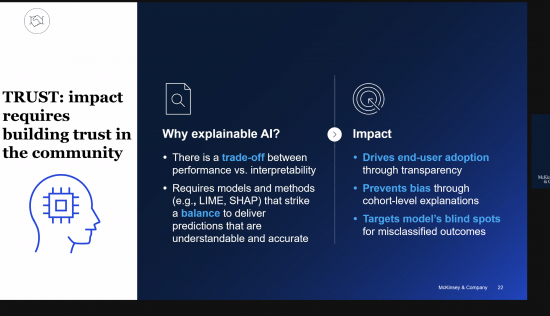
Artificial intelligence gets a lot of buzz as a leading-edge technology in healthcare. But it still has a long way to go when it comes to adoption, with only 20% of physicians saying AI has changed the way they practice medicine, according to a recent survey. In fact, the majority of physicians are anxious or uncomfortable with […]
Barriers to AI Adoption in Healthcare: Burden of Evidence

For AI-based solutions to become part of the daily practice of medicine, A myriad of technical, economic, regulatory, and other forms of barriers exist. Many of these have yet to be addressed sufficiently so the applications of AI in Medicine can truly take off. So, even after many of the data issues we’ve discussed here […]
Model Bias: Part III

No data set can represent the entire universe of options. Thus, it is important to identify the target application and audience upfront, and then tailor the training data to that target. Another possible approach could be to train multiple versions of the algorithm, each of which is trained to input a dataset and classify it, […]
Model Bias: Part II

On another front, AI algorithms are designed to learn patterns in data and match them to an output. There are many AI algorithms, and each has strengths and weaknesses. Deep learning is acknowledged as one of the most powerful today, yet it performs best on large data sets that are well labeled for the precise […]
Model Bias: Part I

Bias in AI occurs when results cannot be generalized widely. Although most people associate algorithm bias resulting from preferences or exclusions in training data, bias can also be introduced by how data is obtained, how algorithms are designed, and how AI outputs are interpreted. This issue touches on concerns that are also more social […]