In this article in Patterns, a Cell journal, the concept of digital twins to improve health outcomes is explored. Dr. Ronald Razmi, Managing Director of Zoi, is one of the authors and was involved in reviewing the research. The digital twin concept allows for predicting the trajectory of an individual’s health based on collecting their personal data, health and otherwise, and using models on that data. While it’s an extremely promising concept for a future in health, where we can anticipate issues years ahead of time and take actions to prevent them, its applications are in the early stages and barriers such as fragmented nature of health data will continue to slow down its rollouts for the foreseeable future.
Dr. Kang Zhang is doing cutting-edge work in this area at Macau University as he has been for quite some time in the health AI space. In addition to being one of the editors of AI Doctor: The Rise of Artificial Intelligence in Healthcare, his many articles based on his top-notch research are references in almost every chapter in the book. He continues to do some of the best envelop-pushing research in this field.
From the article:
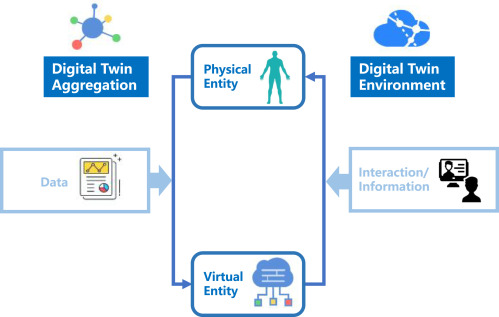
“The DT concept has proven invaluable in industrial applications, from manufacturing to the safe operation of complex systems. Its potential in developing in vitro and in vivo research models is also evident in biomedical research. However, its most transformative application lies in clinical medicine, where DT technologies could realize personalized medicine. By combining high-throughput genetic and molecular approaches, single-cell and whole-genome sequencing, big data, cloud-based electronic medical records, and AI, DTs can deliver modern healthcare.
The digital twin (DT) is a concept widely used in industry to create digital replicas of physical objects or systems. The dynamic, bi-directional link between the physical entity and its digital counterpart enables a real-time update of the digital entity. It can predict perturbations related to the physical object’s function. The obvious applications of DTs in healthcare and medicine are extremely attractive prospects that have the potential to revolutionize patient diagnosis and treatment. However, challenges including technical obstacles, biological heterogeneity, and ethical considerations make it difficult to achieve the desired goal. Advances in multi-modal deep learning methods, embodied AI agents, and the metaverse may mitigate some difficulties. Here, we discuss the basic concepts underlying DTs, the requirements for implementing DTs in medicine, and their current and potential healthcare uses. We also provide our perspective on five hallmarks for a healthcare DT system to advance research in this field.
© 2024 The Authors.